
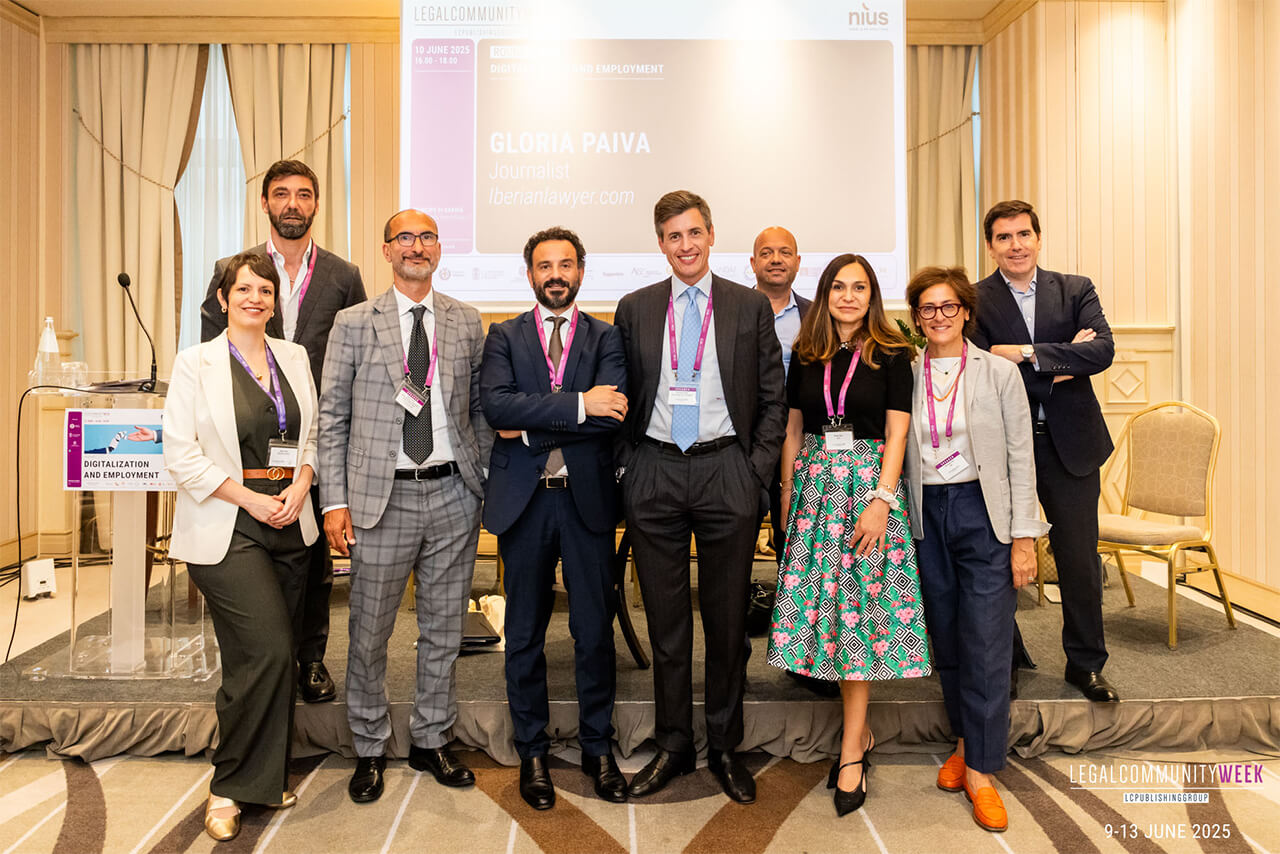
Si è conclusa lo scorso venerdì la nona edizione della Legalcommunity Week, l’appuntamento internazionale dedicato al mondo legale e finanziario organizzato da LC Publishing Group S.p.A.: un’occasione unica di confronto tra professionisti, imprese, studi legali e realtà istituzionali.
Quest’anno NIUS ha partecipato in qualità di Gold Partner, co-organizzando una tavola rotonda di grande attualità a tema “Digitalization and Employment”, che si è tenuta il 10 giugno a Milano, con la moderazione della giornalista Glória Paiva.
I co-fondatori di NIUS, Alessandro Paone e Michela Bani, insieme a un panel di esperti composto da Alessandra Bini, Simone Davini, Carlos Menor, Clemente Perrone, Javier Ramirez Iglesias e Marco Russomando, hanno analizzato il profondo impatto che la digitalizzazione sta avendo sul mondo del lavoro, confrontandosi su aspetti tecnici, giuridici, organizzativi e sociali.
Al centro del dibattito: il controllo remoto dei lavoratori, la protezione dei dati personali (GDPR), i sistemi di valutazione della performance, il ruolo strategico delle risorse umane e le implicazioni nei rapporti tra aziende e autorità fiscali. Temi complessi, ma che hanno concorso a rendere il panel un momento di confronto di alto livello e di respiro internazionale.
«È stato un momento di grande arricchimento, umano e professionale, in cui abbiamo condiviso prospettive, esperienze e competenze per affrontare con lucidità le sfide e le opportunità che gli strumenti digitali stanno offrendo ad aziende e HR manager – hanno commentato gli avv. Paone e Bani -. In un contesto di profonda trasformazione come quello della transizione digitale, il confronto tra professionisti è essenziale per innovare le strutture organizzative e promuovere un futuro del lavoro più flessibile, equo e dinamico».
Abstract degli interventi

Alessandro Paone, Founder, NIUS | Expert Advisor, Ministry of Labour
«Lawyers often approach digitalization from a legal perspective, while managers see it through operational needs. AI brings huge potential, especially through the use of employee data—but managing that data raises complex legal and privacy issues, like email log retention or relationships with non-direct employees, which can trigger scrutiny from tax authorities. Digitalization is a pervasive, system-wide phenomenon that touches every job. Yet our current legal framework struggles to keep up. Labor relations, especially with unions, are essential but challenging, and need to evolve alongside technology. An example is Italy’s Article 7 of the new rule of participation of the labor, which allows companies to establish employee-driven committees to co-design digital organizational models. This could be a real opportunity to move from obligatory union negotiations to a more participatory and proactive approach» .

Michela Bani, Founder, NIUS
«Digitalization is not just about AI: it’s about using digital tools to improve or reinvent how things are done. It’s a long-standing process already embedded in daily business life, as seen with the shift to remote meetings post-pandemic. As a law firm, we support companies through this transformation, especially where it impacts work and human resources. Digitalization enhances efficiency, reduces errors and costs, and creates new business opportunities and jobs, while replacing others. It’s reshaping the nature of work: repetitive tasks are becoming automated, while people move into more strategic, creative, and interpersonal roles, not only in offices but also in manufacturing, logistics, and healthcare. Flexible work arrangements are increasingly common, improving work-life balance and mental well-being. Recruitment is a key area where digitalization is making a strong impact, especially in onboarding. And this is just the beginning: performance, productivity, and all HR processes are now deeply part of this shift» .

Alessandra Bini, Senior Counsel, Compliance Officer Europe – IBM
«At IBM, digitalization has long been part of our daily operations, transforming how we work—often without us even realizing it. A core principle guides this evolution: digital tools and AI are meant to augment, not replace, human capabilities. Human oversight remains essential to govern technology effectively. Digitalization also improves collaboration, inclusion, and empowerment, but only if supported by a strong organizational culture of digitalization. The real challenge for companies is not just adopting tools, but fostering digital literacy, training, and mindset growth. I think that the human factor remains at the core of every digitalization process» .

Simone Davini, Head of Legal & Corporate Affairs – Crédit Agricole CIB
«Digitalization brings several grey areas. First, remote worker monitoring becomes more pervasive, raising legal concerns, especially in Italy, where strict labor laws require union agreements or government authorization. Second, GDPR: digital tools process personal data, so proper consent and legal basis are crucial. Third, performance assessments: because there are studies showing that algorithms can carry biases, risking unfair evaluations and employee demotivation» .

Carlos Menor, Legal Director & Compliance Officer – Groupe Renault España
«At Renault, digitalization in manufacturing is already highly advanced; the use of AI and work optimization has been transformative for years. In contrast, the legal sector is evolving more slowly. Since COVID, in-house legal teams have seen a shift, especially with younger professionals who approach the profession differently. There’s also a clear distinction between law firms and in-house teams: while firms are investing in tools like Harvey, which can take over tasks once handled by junior lawyers, in-house teams prioritize flexibility. Remote work is a win-win when based on trust and accountability. People normally say, “people at home, they do grocery, they take a nap”, but what you have to give your team is trust flexibility. Your work has to be done, and I don’t care when».

Clemente Perrone, Chief People & Organization Officer – Gruppo Sirti
«During last week’s briefing, we chose to shift the conversation from employment to awareness because, from our perspective, awareness is the key foundation for any successful transformation involving people. We’re dealing with companies, with adults and teams, and AI touches everything: from data, processes, and organizational design, to even visual tasks. This is not about assigning a single ‘key role’ : it’s a broader challenge that tests our managerial maturity. HR, however, plays a central role in building both temporary and long-term alignment among C-levels. In our group, we piloted an AI toolset with 50 colleagues from 10 functions, collecting 28 best practices and appointing 8 AI ambassadors. From there, we involved DPO, C-suite, and managers to build knowledge, confidence, and alignment across our business».

Javier Ramirez Iglesias, VP & Associate General Counsel – HP Inc. | Head of Advocacy – ACC Europe
«At HP, we view digitalization as a major opportunity and believe that work shouldn’t feel like work. To understand how the workplace is evolving, we launched the “HP Work Relationship Index” in 2023 and 2024, a global study surveying 1,000 knowledge workers across 12 countries. The findings are striking: only 28% report having a healthy relationship with work, meaning 72% face challenges, partly due to organizational issues. Two key drivers emerged for improving this relationship. First, the use of AI: adoption rose from 38% in 2023 to 66% in 2024, with AI users showing an 11-point higher happiness score compared to non-users. Second, the demand for personalized work experiences: 87% of respondents said they’d give up part of their salary for this, with an average willingness to sacrifice 14% , rising to 19% among Gen Z» .

Marco Russomando, Chief HR & Organization Officer – Illimity Bank
«The real question is: should we rely on potentially biased algorithms to sort candidates, or keep decisions in the hands of all-male management teams that routinely dismiss most female applicants? What the IBM colleagues was explaining before versus the employees, the same that the banks are doing versus the client. In banking, AI is widely used in back-end processes like credit scoring, risk, and finance, while on the front-end it’s improving user experience and customer care, much like how AI supports employees internally. Still, human interaction remains crucial, especially when dealing with complex issues.»


